
Is a Home Freeze Dryer Worth It? Real Costs and Buying Guide
Before you spend thousands on a freeze dryer, make sure it fits both your budget and your routine. This guide walks you through the full cost, the work involved, and the options you can compare.
Quick Answer
A home freeze dryer is worth buying if you’ll use it regularly and the full setup fits your budget. It makes the most sense when you replace freeze-dried food you already buy or save food you’ll actually use. If you only need a few meals for trips or emergencies, buying those foods is usually the better place to start.
See whether it fits your needsWork out your costsThis guide includes a Harvest Right affiliate link. I may earn a commission if you buy through it, at no extra cost to you.
Should you buy, wait, or skip?
You’re ready to use it regularly
You already buy freeze-dried meals or have a steady supply of food to preserve. You have room to run the machine, time to pack the food, and enough money for the full setup.
Next step: Work through the full costs and plan how often you’ll use it.
You like the idea but haven’t made a plan
You’re interested, but you haven’t tried the food or worked out where the machine will go. Check those details and the packing work before choosing a model.
Next step: Try a few freeze-dried foods and plan what you’d dry in a month.
You only need a few meals
For a few trip meals or a small emergency reserve, buying finished food avoids the machine cost and upkeep. Start with that option before spending money on a freeze dryer.
Next step: Build your reserve around foods your household already eats.
Even if the numbers look good, think about how the work will fit into your week. Each batch needs time for food prep, checking, and packing.
How we use ours
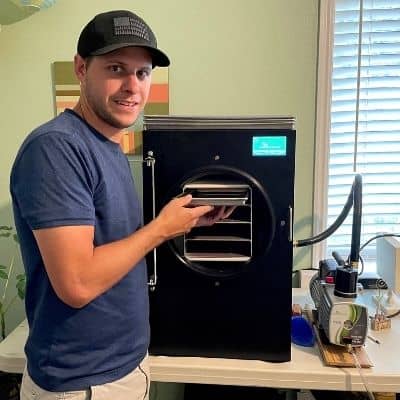
I own a medium Harvest Right freeze dryer, and we use it for garden food, leftovers, camping meals, emergency food, and treats for the kids.
Leftovers are one reason ours gets used. We like to freeze-dry lasagna and taco soup, meals we already make at home. If you’re thinking about buying a machine, start with a few meals your family already eats and ask when you’d use them after drying.
I have used a Harvest Right machine. The Blue Alpine and Stay Fresh comparisons use their published specs, since we haven’t tested those machines.
What does it really cost to get started?
Your startup cost includes more than the machine. Add delivery, supplies, and any work needed to get it running in your home. A written quote for your chosen model and pump will help you build a more complete budget.
| Cost | What to include |
|---|---|
| Machine and pump | Exact size, finish, pump, and any upgrades. |
| Tax and delivery | Shipping fees and how you will move it from the delivery spot. |
| Place to run it | A strong cart or bench, space for the pump, and a drain container. |
| Power setup | Any work needed to meet the model’s power rules. Get a qualified electrician’s quote. |
| Packing supplies | A sealer, bags, oxygen absorbers, and labels. Check what comes in the box. |
| Extras you will use | Spare trays, oil, filters, and other supplies. Leave out extras you do not need. |
Check whether the package includes a pump and starter supplies so you don’t count them twice. An oil-free pump saves you from changing oil, but it costs more. Decide whether that convenience is worth the higher price to you.
See the current brand and model examples as you plan your budget.
What does a batch really cost?
To work out a batch cost, add the food, power, bags, oxygen absorbers, and pump oil it uses. Divide that total by the amount of finished food to find your cost per portion or dried ounce.
For fruit or single ingredients, weigh the dried food and use ounces instead of meal portions.
Compare the same amount of food
Compare dried food with dried food. A pound of fresh strawberries weighs less after the water is removed. Weigh the finished food before comparing its cost with a bag of store-bought dried strawberries.
For meals, match the serving size and calories as closely as you can. A small homemade serving can look cheaper just because it has less food.
A sample batch: how the costs add up
The numbers below are a sample to explain the math. They are not from one of our batches or a claim about typical costs.
- Food: $30.
- Power: 20 kilowatt-hours (kWh) × $0.15 = $3.
- Bags and oxygen absorbers: $5.
- Pump oil used: $1.
- Other batch costs: $3.
In this example, the batch costs $42 and makes 12 portions, so each portion costs $3.50. That covers the running costs listed above. You still need to account for the machine, repairs, and your time.
Suppose eight of those portions replace meals you would have bought for $10 each. That saves $80 in purchases, and subtracting the full $42 batch cost leaves $38 in savings. The other four portions don’t add savings unless they also replace food you would have bought.
Count savings you will actually get
Use what you would normally buy or do as your starting point. If you usually freeze garden produce, compare freeze drying with that option. Comparing it with pricey camping meals you never buy would make the savings look better than they really are.
Even when the food comes from your garden or last night’s dinner, drying it uses power, supplies, and time. Make sure you have a use for the finished food before filling the trays.
To calculate the power cost, multiply the batch’s kilowatt-hours (kWh) by the price per kWh on your bill. The machine’s watt rating alone won’t tell you how much energy the full cycle uses.
How to record your own batch costs
- Write down the food, model, pump, and batch date.
- Weigh the prepared food before drying and the finished food after drying.
- Record the full cycle’s energy use with equipment rated for the load. Follow the machine and meter instructions.
- Add food, oil, packing, and other batch costs.
- Record portions or dried ounces, hands-on time, and extra drying time.
- Save the price and size of the product you would buy instead.
Record several batches so you can see how the costs change with different foods and tray loads.
Will a freeze dryer pay for itself?
A freeze dryer pays for itself when the money you save covers both its running costs and the full setup. To work out how long that takes, divide your startup cost by what you save each month after running costs.
Use the calculator below to work out your batch costs and the food purchases they replace. Choose meal portions or dried ounces, and use the same unit for both homemade and store-bought food.
Choose “Load sample numbers” to see how the example above works. Then replace those numbers with your own costs and plans.
Freeze dryer cost and payback calculator
Use the same food unit throughout: either meal portions or dried ounces. Fill in each running cost, using 0 only when that cost does not apply to your setup.
Your estimate
Compare three batch schedules
See what happens if you run one, four, or eight batches a month. The costs and purchases replaced by each batch stay the same. These are examples, not a suggested schedule.
| Batches/month | Cash saved/month | Cash payback |
|---|
The calculator does not send or save your entries. Its estimate leaves out loan interest, resale value, and future price changes, so add borrowing costs to your budget if you plan to finance the machine.
Treat payback as an estimate, not a promise
The result assumes your costs and use stay the same. Repairs, failed batches, price changes, or months with fewer batches can stretch out the payback time. It also cannot tell you how long the machine will last.
You may also want to choose what goes into your food or store meals your family likes. Those can be good reasons to own a machine even without cash savings, but keep them separate from the cost math.
What is owning a freeze dryer actually like?
A freeze dryer freezes the food, then removes water under a vacuum. It runs the drying cycle for you, but you still prepare the food, check it for dryness, and pack it.
Plan for batches to run for many hours. Harvest Right estimates 13 to 35 hours for most food batches, with some foods taking longer. That is the maker’s estimate, not a time we measured. See Harvest Right’s batch-time guidance.
| Stage | Your part |
|---|---|
| Before a batch | Prepare safe food, fill trays within the model’s limits, and check the pump. |
| During the cycle | Allow for noise, heat, and a long run. Keep the drain and airflow clear as the manual directs. |
| After drying | Check the food, add dry time if needed, and pack it promptly. |
| Between batches | Defrost and clean as directed. Check oil and filters for your pump. |
Utah State University Extension’s home freeze-dryer buying guide covers space, heat, noise, and long cycles. For the exact setup requirements, follow the manual for the model you choose.
Make sure it fits your home
- Space: Measure the machine, pump, open door, airflow room, and path into your home.
- Weight: Include the pump and food when choosing a sturdy surface.
- Power: Follow the exact model’s outlet and circuit rules.
- Room: Check the allowed room temperature. A hot or freezing garage may not work.
- Sound: Choose a spot where the pump will not disrupt sleep or work.
- Timing: Plan to be available when food needs checking and packing.
You can still consider a freeze dryer if you rent. Just check that your space, electrical setup, and lease allow you to use it.
Oil care is different for each pump
I use an oil pump. It has worked well for me, though changing or filtering the oil is one chore I could do without. My brother has an oil-free pump, so he skips the oil changes. If you’re comparing pumps, think about how much that chore matters to you. Follow the service schedule for the exact pump you buy, and ask what you’d pay if it needs a repair.
When is another option better?
You can build a useful food reserve without owning a freeze dryer. Start with the food you want to store and how you’ll use it, then choose a method that fits.
| Your goal | Option to consider first |
|---|---|
| A few trip meals or emergency pouches | Buy finished freeze-dried food. Try it before buying a machine. |
| A short emergency food supply | Build a pantry of shelf-stable foods you already eat. |
| Preserve food you will use soon | Use a freezer you already own, if space and reliable power fit the plan. |
| Dry herbs or make chewy fruit snacks | Compare a dehydrator. The texture and uses differ from freeze-dried food. |
| Preserve suitable foods in jars | Compare canning using a tested recipe and the correct method. |
For occasional use, our freeze-dried food buying guide helps you choose a few foods to try. If you already have freezer space, compare freezing with freeze drying before buying another machine.
Read our freeze-dried versus dehydrated food comparison for a closer look. For a household reserve, start with the food storage calculator.
Which brands should you compare?
Harvest Right, Blue Alpine, and Stay Fresh all make home freeze dryers you can compare. Look for a model that suits the foods and batch sizes you have in mind, then compare the full setup costs.
These U.S. model details were checked on October 5, 2026, using the makers’ prices and specs. The machines differ in size and features, so this comparison does not rank them. Check the selected finish, pump, and bundle before ordering, since prices can change.
Harvest Right
Medium home model: $2,395 sale price for the black model listed when we checked.
- Fresh food per batch
- 10 to 15 lb
- Tray area
- 675 square inches, five trays
- Machine size
- 19 W × 25 D × 29 H inches
- Machine weight
- 119 lb; allow extra room and support for the pump
- Power
- 110 V; dedicated 15 A circuit per its FAQ
The listed package includes an oil pump, trays, sealer, and starter bags and absorbers. Small, large, and extra-large models are also offered.
Blue Alpine
Medium Select: $3,095 for the Sky Blue model with the premium pump listed when we checked.
- Fresh food per batch
- Up to 15 lb
- Trays
- Five 9 × 13-inch trays
- Machine size
- 20 W × 21 D × 30 H inches
- Machine weight
- 110 lb; plan for the separate pump
- Power
- 120 V, 15 A breaker listed
The package includes an oil pump, sealer, trays, mats, and starter bags and absorbers.
Stay Fresh
Standard five-tray: $2,699 with the Premier pump, 110 V version.
- Fresh food per batch
- 12 to 18 lb claimed for the Standard chamber
- Tray area
- 800 square inches; 12-lb ice limit for this setup
- Machine size
- 20 W × 26 D × 31 H inches
- Machine weight
- 165 lb; Premier pump adds 35 lb
- Power
- Dedicated 15/20 A outlet recommended
Starter supplies include a sealer, oil filter, bags, absorbers, and mesh. A seven-tray option adds area but keeps the same 12-lb ice limit with the Premier pump.
Choose a size you can fill and use
Look beyond the number of trays when choosing a size. Tray area, spacing, and the amount of water the machine can remove all affect what fits in a batch. Remember that fresh-food capacity does not tell you the weight of the dried food you’ll store.
Choose a size based on the food you expect to have and the batches you can make time for. A maker’s annual output figure assumes frequent use, so it may be much more than your household will produce.
Check repairs and returns before choosing a brand
Before you choose a brand, read what its warranty covers where you live. A “three-year warranty” can cover fewer parts after the first year, so it’s worth asking:
- Is the pump covered, and for how long?
- Who pays to ship a heavy machine or pump for repair?
- What maintenance records must I keep?
- Can I get parts, and who must approve repair work?
- What are the return deadline, fees, and packaging rules?
For U.S. buyers, all three list one year of broad defect coverage and limited refrigeration coverage through year three. Regions, exclusions, and shipping costs differ.
Read the current terms from Harvest Right, Blue Alpine, and Stay Fresh. We have not run a side-by-side test of speed, sound, or long-term reliability.
If Harvest Right fits your needs, check its current models and prices through our affiliate link.
What safety work comes with the machine?
Freeze drying preserves food, but it does not kill harmful bacteria. That means you still need safe food handling and clean equipment. Utah State University Extension says meat and eggs should be cooked before freeze drying or after rehydration, when water is added back.
If you want a ready-to-eat meal, safely cook the meat or eggs before drying. When the machine finishes, check the food for dryness before packing it. Follow the food and machine guidance rather than treating the finished cycle as proof that every piece is safe.
Read USU’s freeze-drying safety guide and our guide to foods that can and cannot be freeze-dried.
You also should not assume every home batch will last 25 years. Its shelf life is affected by the food, how well it dries, the packaging, and where you store it. Use our packing and shelf-life guide before building a long-term reserve.
Common buying questions
Can it save money on garden food?
Yes, it can save money if it prevents food waste or costs less than your usual way of preserving food. Compare it with what you would actually do, such as freezing or canning, and include power, supplies, and your time. You’ll also need time to process the harvest before it spoils.
Is it worth buying just for emergencies?
For a small emergency reserve, start with purchased food and pantry items. A freeze dryer is easier to justify when you’ll also use it for camping meals or regular food preservation.
Does making more food always save more money?
No. Making more food saves money only if you’ll use it instead of buying food that costs more. Unused food, failed batches, and extra supplies can add costs without adding savings.
Can selling candy pay for the machine?
Selling candy may bring in money, but don’t use hoped-for sales to justify a household purchase. A food business needs its own cost plan and checks of local rules. This calculator covers household use, not business earnings.
How long will a freeze dryer last?
There is no single lifespan you can count on for every machine. Before buying, check the warranty and repair options, and leave room in your budget for upkeep. The payback estimate does not promise that the machine will last that long.
Your buying checklist
Use this checklist to make sure you’ve covered the main costs and work before you order.
The boxes stay checked while this page is open, but they reset if you reload it.
If the full cost fits your budget and the work fits your routine, you have a good reason to consider buying. If you’re still unsure about either one, try the food and finish your plan first. For the next step, use our freeze-drying guides.
About this guide: I own and use a Harvest Right machine. The Blue Alpine and Stay Fresh details come from their published specs, not our own tests. The sample costs explain the math rather than report measured savings, and we have not tested these brands side by side.